Operators managing advanced automatic packaging machines need structured training in safety, HMI controls, format changeovers, packaging materials, quality checks, alarm handling, cleaning, and permitted maintenance. A line operating at 80 packs per minute can process 4,800 packs per hour, so a 10-minute stoppage removes 800 packs of theoretical capacity. Training should combine classroom instruction with supervised machine practice and a practical assessment. Under ISO 12100:2010 principles and workplace safety requirements used across Europe and North America, operators also need clear limits on guard access, energy isolation, jam removal, and technical adjustments. Competence should be demonstrated on the machine, not measured only by training attendance.
An operator first needs to understand what happens between product entry and finished-pack discharge. On a carton line, that may include blank feeding, carton forming, product loading, flap folding, sealing, coding, inspection, rejection, and discharge. At 60 cartons per minute, the equipment completes one carton every second and 3,600 cycles per hour. A sensor positioned a few millimetres incorrectly can therefore repeat the same fault thousands of times during one shift. Training should include component identification, material flow, sensor locations, pneumatic functions, servo-controlled axes, guarding, and the sequence used during normal startup and shutdown.
That mechanical understanding should lead directly into control-system training because modern equipment is rarely operated through physical switches alone. HMIs commonly provide recipe selection, temperature settings, speed references, alarm histories, counters, manual functions, maintenance messages, and access-controlled parameters. A practical course should require trainees to navigate every screen used during normal production rather than memorize a startup sequence.
If a machine is rated at 120 packs per minute and an operator accidentally creates a 5-minute interruption while changing a setting, theoretical lost production reaches 600 packs. The cost of a wrong HMI entry therefore depends on production rate, material cost, and the time required to recognize the error.
Operators should learn which HMI fields they may edit and which require maintenance or engineering authorization. Recipe numbers, product length, film feed, sealing temperature, conveyor speed, sensor delay, carton dimensions, and reject timing may interact. In a facility producing 8 package formats, selecting recipe 06 instead of recipe 05 can change several settings at once. Training should require verification of product code, packaging specification, recipe ID, and first-off samples before continuous production begins.
Once control settings are understood, training needs to move to materials because machine adjustments cannot compensate for every packaging-material variation. Film thickness, carton stiffness, label backing, adhesive condition, print registration, container dimensions, and storage conditions can influence feeding and sealing. A 2% reject rate on 40,000 daily packs creates 800 rejected units; reducing it to 0.5% lowers that figure to 200.
| Training area | Operator should be able to demonstrate | Example production measure |
|---|---|---|
| HMI operation | Load and verify the correct recipe | 100% recipe verification |
| Material loading | Install material in the documented orientation | First-run inspection |
| Quality control | Identify defined package defects | Reject rate by defect |
| Changeover | Install correct format parts and settings | Changeover minutes |
| Alarm recovery | Diagnose permitted routine faults | Repeat alarms per shift |
| Cleaning | Clean specified accessible components | Scheduled completion |
| Safety | Follow guarding and isolation procedures | 100% procedural compliance |
Material training should use actual approved cartons, films, labels, trays, or containers alongside known defective samples. An operator should be able to distinguish a machine fault from a material fault before changing process parameters. If 20 cartons from the same bundle fail to open while cartons from another approved batch run normally, the material batch deserves investigation before guide positions or timing values are changed.
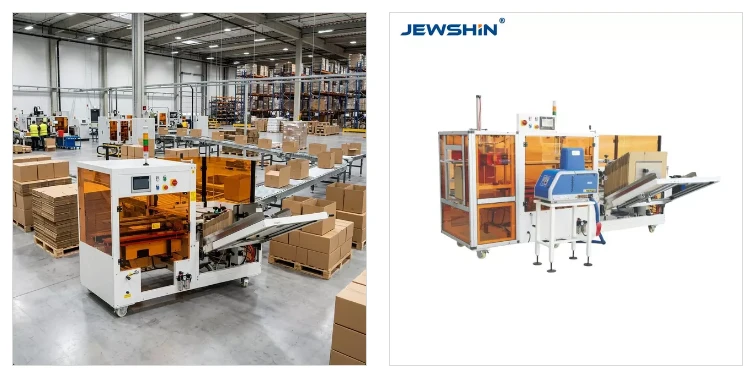
The same principle applies strongly to carton-forming equipment. An automatic carton erector may combine blank storage, vacuum pickup, carton opening, bottom-flap folding, conveying, and sealing in a repeating sequence. Training should cover blank dimensions, magazine loading, vacuum-cup condition, guide adjustment, flap position, tape or adhesive supply, and jam recovery. At 20 cartons per minute, one hour represents 1,200 forming cycles, making small setup errors easy to reproduce at scale.
A useful training test is not “Can the operator start the machine?” A better test gives the trainee a realistic condition: cartons fail to open correctly in 3 of 20 consecutive cycles. The trainee must inspect material placement, vacuum pickup, blank condition, guides, sensors, and permitted settings without bypassing a guard.
Changeover training follows naturally because many setup errors occur when moving from one SKU to another. Operators should receive a documented sequence covering shutdown, line clearance, cleaning, tooling replacement, guide adjustment, recipe loading, material installation, test cycles, inspection, and production release. If a plant makes 6 format changes per day and each change takes 25 minutes, 150 minutes of scheduled production time are involved.
Reducing the same six changeovers from 25 to 18 minutes releases 42 minutes without increasing machine speed. Training should therefore measure repeatability as well as speed. Operators need reference positions for rails, forming tools, sealing components, sensors, pushers, and other adjustable parts. Guessing from the previous product makes the result dependent on individual experience instead of a controlled setup.
Quality inspection should begin immediately after changeover training because a machine that runs continuously can still produce unacceptable packages. Operators may need to inspect seal condition, carton squareness, fill level, label placement, barcode readability, date coding, flap closure, print position, package dimensions, and reject-system operation. Sampling requirements should follow the facility's approved quality plan rather than an arbitrary operator preference.
For example, a line producing 30,000 units during a shift with a 1% defect rate creates 300 defective packages. A 0.2% rate creates 60. Operators need defect definitions that are observable and measurable: missing label, unreadable code, open flap, incomplete seal, damaged carton, wrong product orientation, or package outside the approved dimensional tolerance.
Photographs and physical defect samples improve training because “acceptable seal” can be interpreted differently by two people. A reference sample with an approved specification gives both operators the same comparison point during a 2026 production run or later retraining.
Quality problems then lead into troubleshooting. Operators should be taught to diagnose faults in a fixed order: read the alarm, observe where the process stopped, check product and material position, inspect accessible sensors, confirm utilities, verify permitted settings, correct the authorized cause, run test cycles, and inspect output. Repeatedly pressing reset without finding the cause should not count as troubleshooting.
Alarm history provides useful information here. Suppose a machine records 18 “product not detected” alarms during an 8-hour shift. If 15 occur on one feeder, the pattern is more informative than the total alarm count. Training should show operators how to record alarm type, location, time, product format, material lot when relevant, corrective work, and whether the same fault returned.
Operator authority must remain limited. A trained production operator may clean an accessible photoelectric sensor or correct packaging material position, while servo tuning, electrical cabinet work, PLC modification, and safety-circuit changes normally belong to qualified technical staff. Training needs a written boundary between operator work and maintenance work.
Safety instruction should be taught around real machine tasks rather than a generic presentation. ISO 12100:2010 provides widely used machinery risk-reduction principles, while ISO 13849-1 addresses safety-related parts of control systems. Facility procedures and applicable national rules determine the exact operator responsibilities. Training should cover emergency stops, interlocked doors, fixed guards, hot surfaces, cutting areas, conveyors, pneumatic movement, and stored energy.
A jam provides a useful competency scenario. If a package becomes trapped behind a guard, the trainee should demonstrate the approved stopping and access procedure rather than reaching into the machine because production is waiting. During an 8-hour shift, saving 30 seconds by using an unsafe method offers no acceptable production benefit. Guard switches and safety devices must not be defeated to shorten recovery time.
Cleaning training should follow safety because cleaning often places hands closer to machinery than normal operation does. Operators need documented instructions covering machine state, approved cleaning materials, accessible areas, sensors, sealing surfaces, belts, guides, product-contact parts where applicable, and inspection after cleaning. Food, pharmaceutical, cosmetic, and general industrial packaging lines may have substantially different hygiene requirements.
Daily inspection can also identify deterioration before a full stoppage. Operators can be trained to notice worn vacuum cups, loose guides, damaged belts, unusual pneumatic leakage, contaminated sensors, deteriorating sealing surfaces, or abnormal noise. If a line experiences four 12-minute stoppages in one shift, 48 minutes are lost; identifying a deteriorating component during a planned 5-minute inspection can reduce avoidable interruption.
Maintenance limits should remain visible on the training record. A three-level qualification system is practical: Level 1 for routine operation and inspection, Level 2 for changeovers and approved fault recovery, and Level 3 for specified advanced adjustments after additional technical instruction. The names can vary, but authorization should be documented by machine family rather than assumed from years of service.
Training also needs production-data literacy. Operators should understand good count, reject count, runtime, planned downtime, unplanned downtime, speed, and recurring alarm frequency. If 9,600 good packages are produced during a period in which the theoretical target is 12,000, output is 80% of that target. The operator should be able to identify whether the difference came from stops, reduced running speed, rejects, material waiting, or planned activities.
Data becomes more useful when stoppages are classified consistently. Recording 14 interruptions as “machine problem” gives maintenance little detail; recording 6 product jams, 4 material-feed faults, 3 sensor faults, and 1 pneumatic-pressure interruption provides a usable operating record.
Shift handover should use the same level of detail. A 2024 or 2026 machine log is useful only when entries identify what happened. The outgoing operator should record the active SKU, recipe, material lot where required, unresolved alarms, adjustments, quality observations, maintenance work, and components needing attention. A fault occurring once every two hours can otherwise appear unrelated across three shifts.
Formal qualification should come after supervised practice. A practical assessment can use 20–30 observable tasks, including pre-start inspection, safe startup, recipe verification, material loading, production checks, normal stopping, changeover, cleaning, alarm recovery, jam response, defect identification, and handover documentation. The assessor should record pass, retraining required, or not authorized for each task.
A written test can support the process but should not replace machine demonstration. Someone scoring 95% on a 40-question test may still install a film roll incorrectly or use the wrong jam-clearing procedure. Practical assessment shows whether knowledge transfers to the equipment under normal production conditions.
Refresher training should be tied to changes and performance records rather than treated as a one-time event. Retraining is appropriate after machine modification, software changes, new formats, revised safety procedures, repeated setup errors, or extended absence. An annual review can also confirm that operators still follow the approved method instead of habits developed over time.
Training records should identify the operator, machine or machine family, modules completed, assessment date, assessor, authorization level, and any restrictions. If a facility operates 12 packaging machines with different controls, qualification on one machine should not automatically authorize work on all 12 unless their operating and safety requirements have been formally assessed as equivalent.
A mature program can then measure whether training changes production performance. Useful measures include changeover duration, first-pass acceptance, material waste, repeat alarms, unplanned downtime, setup-related rejects, and safety-procedure compliance. If setup-related rejects fall from 2.4% to 0.8% across 50,000 packages, rejected output falls from 1,200 to 400 units.
Operators managing advanced automation therefore need more than button-level instruction. A suitable qualification combines equipment knowledge, controlled parameter access, material handling, quality inspection, documented changeovers, structured fault diagnosis, safe intervention, basic equipment care, data recording, and demonstrated machine competence. For a high-speed line producing tens of thousands of packages per shift, small improvements measured in 0.5%, 10 minutes, or a few repeated alarms can represent hundreds of packages and several hours of production time across a working month.